
Brain Health at Every Age: A Life-Course Guide
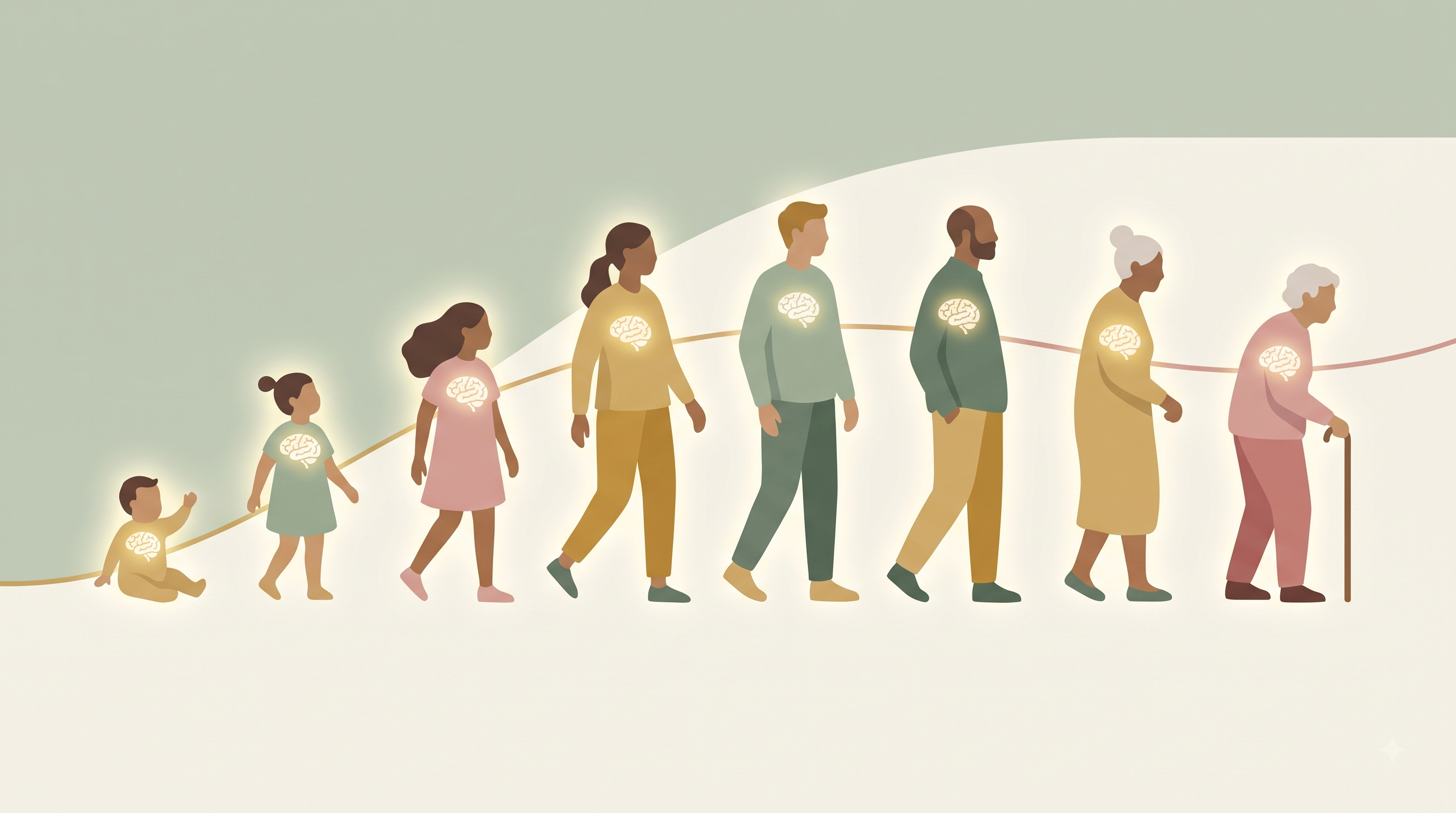
Brain health isn't something you start worrying about in old age — it's built, quietly, across an entire lifetime, and the evidence increasingly shows that what you do in your 20s, 40s, and 60s all leaves a mark on the brain you'll have at 80.
Brain health isn't something you start worrying about in old age — it's built, quietly, across an entire lifetime, and the evidence increasingly shows that what you do in your 20s, 40s, and 60s all leaves a mark on the brain you'll have at 80. The most reassuring finding in modern brain science is that a large share of dementia risk is tied to factors we can influence, and that there's a meaningful lever at every stage of life. It's rarely too early to start and rarely too late to benefit. The habits differ a little by decade, but the throughline is the same: what's good for your heart, your sleep, your body, and your relationships is good for your brain.
Marking World Brain Day, here's what matters most, and when.
The big picture: a lifetime, not a moment
The most important reframe in brain-health science is that dementia risk accumulates over decades. The landmark Lancet Commission on dementia estimates that around 45% of dementia cases are linked to modifiable risk factors spread *across the entire life course* — from education in early life, through cardiovascular and lifestyle factors in midlife, to sensory and social factors in later life.
That framing does two things. It dismantles the idea that brain health is only a concern for the old — the groundwork is laid far earlier. And it's deeply hopeful, because it means there's something useful to do at every stage. The brain you have at 80 is shaped by choices made at 30, 50, and 70 — and by the reserve you build the whole way through.
A crucial caveat before the decade-by-decade guide: these are population patterns, not guarantees. Doing everything "right" doesn't make anyone immune, and developing dementia is never a personal failure. The point isn't perfection — it's shifting the odds, at whatever age you are.
In your 20s and 30s: build the foundation
Brain health in early adulthood rarely feels urgent, and that's exactly why it's underrated. This is the time to build habits and reserve that pay dividends for decades.
- Build cognitive reserve. Education, learning, and mentally demanding work in early life help construct the cognitive reserve that buffers the brain later. Keep challenging your mind.
- Establish the fundamentals. The exercise, sleep, and eating patterns you set now tend to persist. Starting them early makes them automatic later.
- Protect your head. Traumatic brain injury is a modifiable risk factor — helmets, seatbelts, and avoiding repeated head impacts matter more than young adults tend to think.
- Mind mental health. Depression is linked to dementia risk, and untreated mental-health conditions in early adulthood are worth taking seriously for many reasons, including this one.
In your 40s and 50s: the high-leverage midlife window
If there's a single most important window, the evidence points here. Many of the strongest modifiable risk factors operate in midlife, and this is where prevention has the most traction.
- Treat your cardiovascular health as brain health. Blood pressure, cholesterol, and blood sugar in midlife are among the most consequential factors for later brain health. What's good for the heart is good for the brain isn't a slogan — it's one of the best-supported findings in the field. (Managing blood sugar matters especially.)
- Stay physically active. Exercise supports the brain through multiple pathways and helps control the cardiovascular factors above.
- Address hearing early. Hearing loss is the single largest modifiable risk factor; midlife is when to start protecting and checking your hearing.
- Protect your sleep. Chronically short sleep in midlife is associated with higher later dementia risk, and this is the decade sleep often gets sacrificed to work and family.
- Don't ignore midlife mental health, including, for women, the cognitive changes of the menopause transition — real, usually temporary, and a prompt to tend sleep, mood, and cardiovascular health.
In your 60s, 70s, and beyond: protect and engage
Later life is not too late — reducing risk factors here still appears to help. The emphasis shifts toward maintaining function, connection, and the senses.
- Stay socially connected. Loneliness and isolation are meaningful later-life risk factors. Actively tending relationships is brain health, not just wellbeing.
- Keep your senses working. Correct hearing and vision — both are modifiable later-life risk factors and both are very actionable.
- Keep moving and learning. Continued physical activity and mental engagement support the brain into old age; the goal is a life with challenge and meaning in it, not a brain-training app.
- Manage health conditions and medications. Well-controlled cardiovascular and metabolic health continues to matter, and reviewing medications with a doctor can catch reversible contributors to cognitive change.
- Take memory changes seriously but not fearfully. Know the difference between normal aging and warning signs, and seek evaluation early rather than waiting — many causes are treatable.
The habits that matter at every age
Strip away the decade-specific emphasis and the core is remarkably consistent. At any age, the evidence rewards:
- Protecting cardiovascular and metabolic health
- Regular physical activity
- Good-quality sleep
- Mental challenge and continued learning
- Meaningful social connection
- Protecting hearing, vision, and your head
- Not smoking, and keeping alcohol moderate
There's no supplement, gadget, or shortcut on that list — because the evidence keeps pointing to the unglamorous fundamentals, applied consistently over time.
That's the real message of a life-course view of brain health, and a fitting one for World Brain Day: your brain is being shaped every decade, by ordinary choices, and it's never the wrong time to start tending it. The 20-year-old building reserve, the 50-year-old managing blood pressure, and the 75-year-old staying connected are all doing the same essential work — caring for the organ that makes them who they are, one ordinary, powerful habit at a time.
For the deeper dive on prevention specifically, see Can Alzheimer's Be Prevented?
*Brain Meets Bytes — Science First. Human Always. Subscribe for clear, evidence-based brain-health insight.*
This article is for general education and is not medical advice. Speak with a qualified healthcare professional about your individual brain health.
Frequently asked questions
- How can I keep my brain healthy at every age?
- Focus on the core habits that matter across life: protect cardiovascular and metabolic health, stay physically active, sleep well, keep learning and mentally engaged, maintain social connection, protect your hearing, vision, and head, and avoid smoking. The emphasis shifts by decade, but the fundamentals stay the same.
- What's the most important age for brain health?
- Midlife (roughly your 40s–60s) is an especially high-leverage window, because many of the strongest modifiable risk factors — blood pressure, cholesterol, blood sugar, hearing, sleep — operate then. But every life stage matters: reserve is built early and reducing risk factors later still helps.
- Is it ever too late to improve brain health?
- No. While earlier action does more, reducing risk factors in later life still appears beneficial. Staying active, connected, and engaged, and correcting hearing and vision, are worthwhile at any age.